
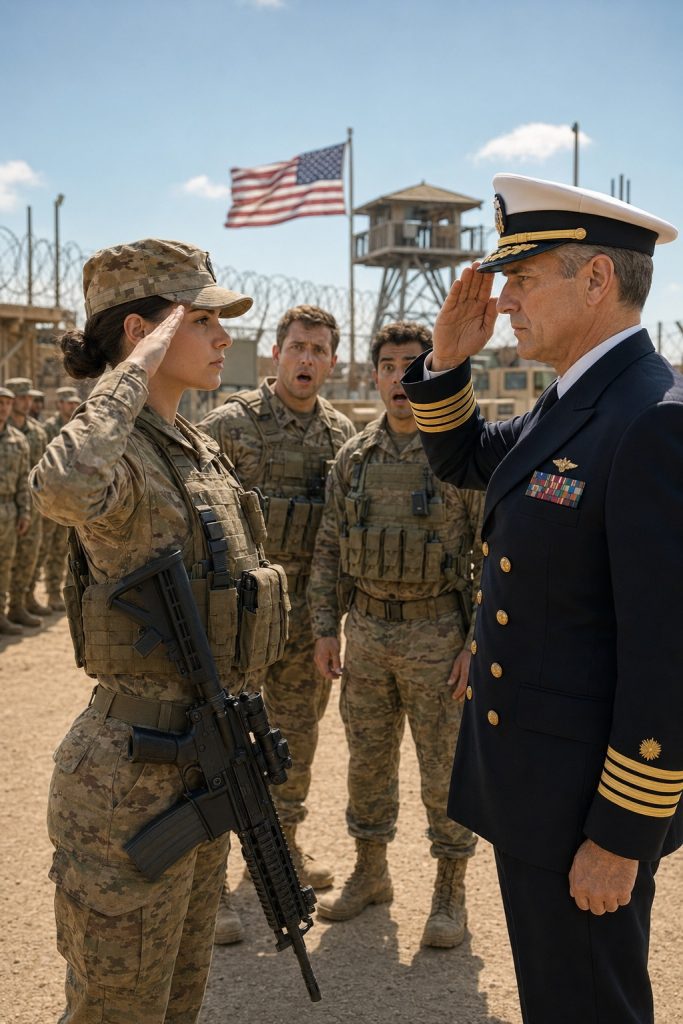
“She was just a gate guard—until a Navy SEAL commander saluted her first.
‘They told me I was just a girl with a rifle standing next a traffic cone.’
That’s what I heard through the cracked window of the guard shack at Naval Station Norfolk, as the August heat baked the asphalt and sweat dripped down my neck.
They were laughing because I checked every ID like the base depended on it.
They were laughing because I corrected officers two ranks above me.
They were laughing because I treated gate duty like war.
Then a black SUV pulled up.
A decorated Navy SEAL commander stepped out.
And in front of everyone who had mocked me…
He saluted me first.
PART 1 — The Gate Girl
‘They put you on gate because nobody trusts you with real work.’
Corporal Mason said it loud enough for me to hear.
He was leaning against the concrete barrier, sunglasses pushed up on his head, laughing with two Marines who had already spent half the morning joking about last night’s drinking and how boring this post was.
I didn’t answer.
I stood straight.
I checked the next ID.
Because my father taught me something before I raised my right hand and enlisted.
‘Respect is built when no one is watching.’
So I acted like someone was watching.
Every second.
Every vehicle.
Every face.
Naval Station Norfolk woke up before the sun rose. Trucks rumbling toward the piers. Sailors crossing the street, coffee in one hand, paperwork in the other. Marines running along the perimeter road, their boots hitting the pavement in rhythm.
And I was there.
Private First Class Emma Harris.
Twenty-one years old.
Sunburned.
Sweating through my uniform.
Assigned to the main gate like I was a piece of furniture.
To most people, gate duty was a punishment.
To me, it was the first line between the outside world and everything this base protected.
Weapons.
Operations.
Families.
Classified rooms I would probably never be allowed inside.
So I checked every badge.
I looked every driver in the eye.
I watched every hand.
And every time someone rolled their eyes at me, I reminded myself of something else my father said.
‘People who hate discipline usually hate it because they don’t have any.’
By 9 a.m., the heat was brutal.
The asphalt shimmered.
My throat was dry.
My stomach growled because I had skipped breakfast to make it to inspection on time.
Still, I didn’t lean.
I didn’t wipe my forehead.
I didn’t complain.
‘Next vehicle,’ I announced.
A civilian contractor in a white pickup truck pulled up, phone pressed to his ear.
He handed me his ID without looking at me.
I held it.
‘Sir, I need you to end the call while I verify.’
He stared at me like I had slapped him.
‘You serious?’
‘Yes, sir.’
He sighed theatrically, ended the call, and muttered, ‘The gate girl thinks she runs the Pentagon.’
The Marines behind me laughed.
I scanned his badge.
I checked the holographic strip.
I compared his face.
Then I handed it back.
‘You’re clear. Drive safe.’
His tires squealed a little as he pulled away.
Mason walked over.
‘You know, Harris, you don’t get bonus points for playing robot.’
I kept my eyes on the lane.
‘You don’t lose any for doing your job right either.’
His smile faded.
That’s when the black SUV appeared at the end of the line.
I didn’t know why, but the whole checkpoint changed.
The joking stopped.
One Marine straightened up so fast the sling on his rifle snapped against his vest.
Another whispered, ‘No way.’
The SUV rolled forward slowly, its black paint gleaming in the sun, the windows tinted dark enough to hide whoever was inside.
My pulse spiked once.
Then I forced it back down.
No matter who was inside, the rules were the rules.
The driver’s window rolled down.
The man inside looked like he was carved from war and silence.
Short hair.
Hard jaw.
Calm eyes.
Not angry.
Not friendly.
Just alert in a way that made every slacker around suddenly aware of their own breathing.
He handed me his ID.
Commander James Ror.
My fingers almost tightened on the card.
Almost.
Everyone on base knew that name.
Decorated Navy SEAL.
Rescue missions spoken of only in whispers.
A man who had gone places most people only saw in their nightmares and brought his men home.
Behind me, Mason held his breath.
I could feel him watching, waiting for me to rush.
To panic.
To wave the commander through because he was important.
Instead, I checked the badge like I checked every badge.
Expiration date.
Photo.
Security strip.
Access code.
Face.
Hands.
Vehicle.
My voice stayed steady.
‘Thank you, sir. You’re clear to proceed.’
Commander Ror didn’t move.
His eyes stayed on me.
For a long second, the whole base seemed to hold its breath.
Then he opened the door.
The SUV door closed with a solid thud that silenced every whisper at the gate.
He stepped out.
Not quickly.
Not dramatically.
Just with the quiet certainty of a man used to walking into rooms where death waited and making death blink first.
I locked my knees.
He walked straight toward me.
Mason muttered behind me, ‘What did you do?’
I didn’t know.
Commander Ror stopped in front of me.
I could hear the engines idling.
I could hear the flag flapping softly near the entrance.
I could hear my own heart beating so loud it sounded like a drum under my ribs.
‘Private Harris,’ he said.
‘Yes, sir.’
His eyes swept over my uniform, my posture, the notepad tucked against my side, the badge reader in my hand.
Then he did what no one expected.
He raised his hand.
And returned me a salute.
A full salute.
Precise.
Deliberate.
Respectful.
For half a second, my mind went blank.
A commander was saluting me.
A SEAL commander.
At the main gate.
In front of men who had spent the morning mocking me.
My body reacted before my thoughts caught up.
I snapped to attention and returned the salute with everything I had.
No one moved.
No one breathed.
Then Commander Ror lowered his hand.
He gave me a small nod.
Not warm.
Not soft.
But genuine.
Then he got back in the SUV and drove through the gate.
The silence broke after he passed.
‘Holy hell,’ someone whispered.
Mason didn’t laugh.
For the first time all morning, he looked scared.
By lunch, the whole base knew.
By dinner, people were pointing at me in the mess hall.
By lights out, my bunkmate Torres was lying on her rack, reading messages from three different group chats.
‘Oh my God,’ she said, laughing. ‘You’re famous.’
‘I’m not famous.’
‘You made Commander Ror salute first.’
‘I didn’t make him do anything.’
She rolled over and looked at me.
‘Then why did he do it?’
I stared at the ceiling.
I didn’t know.
That was what bothered me most.
I hadn’t done anything heroic.
I hadn’t stopped an attacker.
Saved a life.
Pulled a kid from a burning car.
I just stood at a gate and did my job while others treated that job like a joke.
The next morning, First Sergeant Daniels called me into his office.
He didn’t smile.
He never smiled.
But that day, he looked at me like I had accidentally stepped into something bigger than myself.
‘Private Harris.’
‘Yes, First Sergeant.’
‘Commander Ror requested you for a temporary assignment.’
My stomach tightened.
‘Requested?’
‘Personally.’
I waited for him to explain.
He didn’t.
‘You will report to Building 12 tomorrow at 0700.’
Building 12.
Restricted compound.
SEAL operations.
The kind of place soldiers only entered if they were lost, invited, or in serious trouble.
Daniels leaned forward.
‘Listen to me carefully. I don’t know what he sees in you. I don’t know why he saluted you. But when a man like Ror opens a door, you don’t stumble through it.’
‘Yes, First Sergeant.’
‘And Harris?’
I stopped at the door.
‘Don’t give those who mocked you the satisfaction of being right.’
That night, I didn’t sleep.
Because in less than twenty-four hours, I would no longer be the gate girl.
And something told me the real test was just beginning…”
————————————————————————————————————————
“She was just holding the gate — until a Navy SEAL commander saluted her first.
‘They told me I was just a girl with a rifle standing next to a traffic cone.’
That’s what I heard through the cracked window of the guard shack at Naval Station Norfolk, as the August heat baked the asphalt and sweat dripped down my neck.
They were laughing because I checked every ID like the base depended on it.
They were laughing because I corrected officers twice my rank.
They were laughing because I treated gate duty like war.
Then a black SUV pulled up.
A decorated Navy SEAL commander stepped out.
And in front of everyone who had mocked me…
He saluted me first.
PART 1 — The Gate Girl
‘They put you on gate duty because nobody trusts you with real work.’
Corporal Mason said it loud enough for me to hear.
He was leaning against the concrete barrier, his sunglasses pushed up on his head, laughing with two Marines who had already spent half the morning joking about last night’s bar run and how boring this post was.
I didn’t answer.
I stood straight.
I checked the next ID.
Because my father taught me one thing before I raised my right hand and enlisted.
‘Respect is built when no one is watching.’
So I acted like someone was watching.
Every second.
Every vehicle.
Every face.
Naval Station Norfolk woke up before the sun rose. Trucks rumbling toward the piers. Sailors crossing the street, coffee in one hand and files in the other. Marines running along the perimeter road, their boots hitting the pavement in rhythm.
And I was there.
Private First Class Emma Harris.
Twenty-one years old.
Sunburned.
Sweating through my uniform.
Assigned to the main gate like I was a piece of furniture.
For most people, gate duty was a punishment.
For me, it was the first line between the outside world and everything this base protected.
Weapons.
Operations.
Families.
Classified rooms I would probably never be allowed into.
So I checked every badge.
I looked every driver in the eye.
I watched every hand.
And every time someone rolled their eyes at me, I remembered something else my father said.
‘People who hate discipline usually hate it because they don’t have any.’
By 9:00 AM, the heat was brutal.
The asphalt shimmered.
My throat was dry.
My stomach growled because I had skipped breakfast to make it to inspection on time.
Still, I didn’t lean.
I didn’t wipe my forehead.
I didn’t complain.
‘Next vehicle,’ I called out.
A civilian contractor in a white pickup truck pulled up, phone pressed to his ear.
He handed me his ID without looking at me.
I held it.
‘Sir, I need you to hang up while I verify.’
He looked at me like I had slapped him.
‘Are you serious?’
‘Yes, sir.’
He sighed theatrically, ended the call, and muttered, ‘The gate girl thinks she runs the Pentagon.’
The Marines behind me laughed.
I scanned his badge.
I checked the holographic strip.
I compared his face.
Then I handed it back.
‘You’re clear. Drive safe.’
His tires chirped a little as he pulled away.
Mason walked over.
‘You know, Harris, you don’t get extra points for being a robot.’
I kept my eyes on the lane.
‘You don’t lose points for doing your job right either.’
His smile faded.
That’s when the black SUV appeared at the end of the line.
I didn’t know why, but the whole checkpoint changed.
The joking stopped.
One Marine straightened up so fast the sling on his rifle snapped against his vest.
Another whispered, ‘No way.’
The SUV rolled forward slowly, the black paint gleaming in the sun, the windows tinted dark enough to hide whoever was inside.
My pulse spiked once.
Then I forced it back down.
No matter who was inside, the rules were the rules.
The driver’s window rolled down.
The man inside looked like he was carved from war and silence.
Short hair.
Hard jaw.
Calm eyes.
Not angry.
Not friendly.
Just alert in a way that made every lazy person nearby suddenly aware of their own breathing.
He handed me his ID.
Commander James Ror.
My fingers almost tightened on the card.
Almost.
Everyone on base knew that name.
Decorated Navy SEAL.
Rescue missions spoken of only in whispers.
A man who had been to places most people only saw in nightmares and brought his men home.
Behind me, Mason inhaled sharply.
I could feel him watching me, waiting for me to rush.
To panic.
To wave the commander through because he was important.
Instead, I checked the badge like I checked every badge.
Expiration date.
Photo.
Security strip.
Access code.
Face.
Hands.
Vehicle.
My voice stayed even.
‘Thank you, sir. You’re clear to proceed.’
Commander Ror didn’t move.
His eyes stayed on me.
For a long second, the whole base seemed to hold its breath.
Then he opened the door.
The SUV door closed with a solid thud that silenced every murmur at the gate.
He stepped out.
Not fast.
Not theatrical.
Just with the quiet certainty of a man used to walking into rooms where death was waiting and making death blink first.
I locked my knees.
He walked straight toward me.
Mason muttered behind me, ‘What did you do?’
I didn’t know.
Commander Ror stopped in front of me.
I could hear engines idling.
I could hear the flag flapping softly near the entrance.
I could hear my own heart beating so hard it sounded like a drum under my ribs.
‘Private Harris,’ he said.
‘Yes, sir.’
His eyes ran over my uniform, my posture, the clipboard tucked against my side, the card reader in my hand.
Then he did something no one expected.
He raised his hand.
And returned my salute.
A full salute.
Sharp.
Deliberate.
Respectful.
For half a second, my mind went blank.
A commander was saluting me.
A SEAL commander.
At the main gate.
In front of men who had spent the morning mocking me.
My body reacted before my thoughts caught up.
I snapped to attention and returned the salute with everything I had.
No one moved.
No one breathed.
Then Commander Ror lowered his hand.
He gave me a small nod.
Not warm.
Not soft.
But real.
Then he got back in the SUV and drove through the gate.
The silence broke after he passed.
‘Holy hell,’ someone whispered.
Mason didn’t laugh.
For the first time all morning, he looked scared.
By noon, the whole base knew.
By dinner, people were pointing at me in the mess hall.
By lights out, my roommate Torres was lying on her bunk, reading messages from three different group chats.
‘Oh my God,’ she said, laughing. ‘You’re famous.’
‘I’m not famous.’
‘You made Commander Ror salute first.’
‘I didn’t make him salute.’
She rolled over and looked at me.
‘Then why did he?’
I stared at the ceiling.
I didn’t know.
That was the part that bothered me most.
I hadn’t done anything heroic.
I hadn’t stopped any attackers.
Saved any lives.
Pulled any kids out of a burning car.
I had just stood at a gate and done my job while others treated that job like a joke.
The next morning, First Sergeant Daniels called me into his office.
He wasn’t smiling.
He never smiled.
But that day, he looked at me like I had accidentally stepped into something bigger than myself.
‘Private Harris.’
‘Yes, First Sergeant.’
‘Commander Ror requested you for a temporary assignment.’
My stomach tightened.
‘He requested me?’
‘Personally.’
I waited for him to explain.
He didn’t.
‘You will report to Building 12 tomorrow at 0700.’
Building 12.
Restricted compound.
SEAL operations.
The kind of place privates only entered if they were lost, invited, or in serious trouble.
Daniels leaned forward.
‘Listen to me carefully. I don’t know what he sees in you. I don’t know why he saluted you. But when a man like Ror opens a door, you don’t stumble through it.’
‘Yes, First Sergeant.’
‘And Harris?’
I stopped at the door.
‘Don’t give the people who mock you the satisfaction of being right.’
That night, I didn’t sleep.
Because in less than twenty-four hours, I wouldn’t be the gate girl anymore.
And something told me the real test was just beginning.
PART 2 — Building 12
‘You don’t belong here,’ the petty officer said before he even finished reading my orders.
He stood at the entrance to Building 12, one eyebrow raised, like my paperwork was a joke.
I kept my voice calm.
‘Commander Ror requested me, sir.’
His face changed.
Not much.
But enough.
He scanned the orders again, slower this time.
Then he opened the door.
The air inside Building 12 was cold enough to give me goosebumps on my arms.
The hallway smelled like burnt coffee, printer toner, and gun oil.
Doors lined both sides, marked with coded numbers and restricted access signs.
No loud voices.
No joking.
No unnecessary movement.
Every person who passed me looked like they had an urgent place to be and no patience for anyone standing in their way.
I followed a young lieutenant to an office at the end of the hall.
Commander Ror stood behind the desk, sleeves rolled up, an open file in front of him.
He didn’t look surprised to see me.
He looked like he had been waiting for me since before I knew I was coming.
‘Private Harris.’
‘Sir.’
I saluted.
He returned it.
Then he closed the file.
‘Do you know why you’re here?’
‘No, sir.’
‘Good. Honest answer.’
I stood still.
He walked around the desk and stopped in front of me.
‘I’ve been watching you at the gate.’
My throat tightened.
‘Most people treat small tasks like they’re beneath them. They slouch. They rush. They take shortcuts when they think no one important is watching.’
His eyes sharpened.
‘You didn’t.’
I didn’t know what to say.
So I told the truth.
‘It was my post, sir.’
‘Yes,’ he said. ‘And you treated it like it mattered.’
A strange warmth spread through my chest.
Not pride.
Not exactly.
Something heavier.
Recognition.
‘People think I saluted you because I wanted to make a statement,’ he said. ‘They’re half right.’
He turned back to his desk.
‘I wanted everyone at that gate to understand something. Rank is given. Respect is earned.’
He picked up a file and handed it to me.
‘But a salute is just the beginning. Now I want to know if your discipline survives pressure.’
I looked at the file.
Schedules.
Logs.
Names.
Rooms.
Times.
Coordinates.
‘Your assignment is administrative support,’ he said. ‘You will organize briefings, verify logs, deliver files, and report anything that seems off.’
A petty officer near the wall snorted softly.
Commander Ror didn’t look at him.
But the room froze.
‘Don’t confuse administrative with unimportant,’ Ror continued. ‘A wrong time can delay a team. A wrong grid can send men to the wrong place. A missing name can leave someone behind.’
He stepped closer.
‘Mistakes here don’t cost pride, Harris. They cost lives.’
The file felt heavier in my hands.
‘Yes, sir.’
My first week in Building 12 almost broke me.
Not physically.
Mentally.
At the gate, the rules were clear.
Check IDs.
Watch hands.
Follow protocol.
Inside Building 12, everything moved in layers.
Schedules changed.
Officers changed rooms.
Files arrived with red stamps.
Phones rang with coded messages.
Whiteboards contained timelines I wasn’t fully cleared to understand but had to support perfectly anyway.
I sat at a small desk outside the operations wing and learned quickly that people resented me.
Not everyone.
But enough.
One lieutenant dropped a stack of forms on my desk and said, ‘Try not to lose these, Gate Girl.’
I looked up.
He smiled like he expected me to shrink.
I didn’t.
‘I’ll log and file them by 1400, sir.’
His smile thinned.
‘Ambitious.’
‘No, sir. Precise.’
He walked away.
I filed them at 1330.
The whispers followed me everywhere.
‘That’s Ror’s pet project.’
‘She got lucky.’
‘One salute and now she thinks she matters.’
I heard every word.
I remembered every voice.
But I didn’t answer.
I watched.
I learned.
I worked.
Every evening, I went back to the barracks with burning eyes and cramped fingers from taking notes.
Torres would toss me a protein bar and say, ‘Looks like Building 12 chewed you up and spit you out.’
‘Not yet,’ I’d say.
But some nights, I wasn’t sure.
Then came the first real test.
It was after 1900.
Most of the offices were empty.
I was checking a mission support file before locking it in the cabinet when I noticed something off.
Two times didn’t match.
The briefing sheet said 2300.
The operational note said 0200.
Three hours difference.
Maybe it was nothing.
Maybe the update had changed and no one had told me.
Maybe I was just a private reading above my pay grade.
Then I heard Ror’s voice in my head.
Mistakes here cost lives.
I took the file to his office.
The door was cracked open.
He looked up.
‘Private?’
‘Sir, there’s a discrepancy in the times.’
He took the file.
Read one page.
Then another.
His expression didn’t change, but the air did.
‘Who gave you this?’
‘Lieutenant Crane, sir.’
‘And you noticed it?’
‘Yes, sir.’
He pressed a button on his phone.
‘Lieutenant Crane. My office. Now.’
Crane arrived two minutes later, looking annoyed.
Until he saw the file in Ror’s hand.
Ror placed both pages on the desk.
‘Explain.’
Crane looked down.
Then up.
Then down again.
‘I must have missed the update.’
Ror’s voice dropped.
‘You missed a three-hour difference in an operational support file.’
Crane swallowed.
‘I was going to check it later.’
‘No,’ Ror said. ‘Private Harris checked it now.’
Crane’s face flushed.
I kept my eyes straight ahead.
Ror looked at me.
‘Good catch.’
Two words.
That was all.
But Lieutenant Crane never called me Gate Girl again.
The second test came four days later.
A supply request crossed my desk with mismatched codes.
The item number belonged to communication batteries.
The description listed medical kits.
I flagged it.
The logistics chief tried to wave me off.
‘It’s probably a template error.’
‘Probably doesn’t belong in a restricted file,’ I said.
He looked at me.
I looked at him.
Twenty minutes later, they discovered the wrong code would have routed the shipment to the warehouse instead of loading it for deployment.
The third test was worse.
I found a personnel manifest with a missing name.
A sailor.
A real human being erased by a clerical error.
When I reported it, the room went silent.
Not an annoyed silence.
A scared silence.
Commander Ror stood at the head of the conference table and looked at every officer in the room.
‘A private caught what six of you signed off on.’
No one spoke.
Then he looked at me.
Not with surprise.
With confirmation.
Like he had always known what I would do.
That evening, First Sergeant Daniels stopped me outside the mess hall.
‘Harris.’
‘Yes, First Sergeant.’
‘I heard about the manifest.’
I braced myself.
‘You made enemies today.’
‘I know.’
‘You also saved someone’s career. Maybe more than that.’
I didn’t answer.
He looked at the American flag moving in the evening wind next to the building.
Then he said quietly, ‘Your father military?’
‘Yes, First Sergeant. Army. Retired.’
‘Tell him he raised you right.’
I stood there after he left, unable to move for a moment.
For the first time since the salute, I understood something.
Commander Ror hadn’t saved me from the gate.
He had dragged me into a place where my discipline could either prove itself…
Or expose me.
And the next mistake I found wouldn’t just embarrass someone.
It would uncover a secret they were desperate to keep buried.
PART 3 — The File They Tried to Hide
‘Private Harris needs to learn her place before she ruins someone important.’
I heard it through the supply room door.
The voice belonged to Lieutenant Crane.
The same officer whose timing error I had caught.
He wasn’t alone.
A second voice answered, low and tense.
‘She’s already ruined enough. Ror is watching everything she touches now.’
Crane swore.
‘She’s a private. A nobody. She should still be sweating at the gate.’
I stood in front of the door, a stack of files in my hands, my hand frozen on the top folder.
A month ago, those words would have torn me apart.
Now they only sharpened me.
The second voice said, ‘Then stop giving her things to catch.’
The room went quiet.
I walked away before they opened the door.
I didn’t run.
I didn’t cry.
I went back to my desk.
And I started checking everything twice.
That afternoon, a sealed file landed in my inbox.
No sender name.
No routing slip.
Just a red ‘restricted’ stamp and a handwritten note.
PROCESS BEFORE 1700.
I frowned.
Every file in Building 12 had a chain.
Who created it.
Who reviewed it.
Who approved it.
This one had nothing.
I opened the outer folder.
Inside was a transport authorization.
Three vehicles.
Two drivers.
An after-hours access window.
Destination: pier warehouse.
Purpose: equipment relocation.
On the surface, it looked routine.
But routine paperwork had become my favorite.
Routine was where careless people hid dangerous things.
The driver names were familiar.
The access window was unusual.
The approval signature looked rushed.
Then I saw it.
Commander Ror’s signature.
Except it was fake.
Not obviously fake.
Not enough for a lazy person to notice.
But I had spent weeks seeing his signature on memos, approvals, and commendation drafts.
His R always dropped sharply.
This one curved.
His middle initial usually leaned right.
This one was straight.
My pulse slowed.
Not sped up.
Slowed.
That’s how I knew I was scared.
I scanned the document and logged it as questionable.
Then I checked the camera access log for the document room.
I wasn’t supposed to have full clearance, but part of my job was matching file movements with delivery times.
The file appeared in my inbox at 1422.
The hallway camera showed Lieutenant Crane near my desk at 1419.
His hands were empty when he arrived.
Not empty when he left.
I watched the clip twice.
Then I saved it.
Quietly.
At 1600, Crane walked by.
‘Did you process that transport file?’
His tone was too casual.
I looked up.
‘I’m still verifying, sir.’
His jaw tightened.
‘It’s urgent.’
‘Yes, sir. That’s why I’m verifying.’
He leaned close enough for me to smell coffee on his breath.
‘You’re building a reputation, Harris. Not a good one.’
I kept my voice low.
‘For accuracy?’
‘For arrogance.’
He tapped the file.
‘Process it.’
Then he walked away.
I didn’t process it.
I went to Commander Ror’s office.
He was in a meeting.
The lieutenant at the outer desk said, ‘He can’t be disturbed.’
I held up the file.
‘He can for this.’
The lieutenant looked annoyed until he saw my face.
Then he knocked.
Ror opened the door himself.
His eyes dropped to the file.
Then to me.
‘What is it?’
‘I believe someone forged your signature on a transport authorization.’
The room behind him went deathly silent.
Every officer turned.
Ror took the file.
Read it.
His face didn’t change.
That was worse than anger.
‘Who brought you this?’
‘It was dropped in my inbox, sir. No routing slip. Camera log shows Lieutenant Crane near my desk three minutes before it appeared.’
Crane, sitting at the conference table, went pale.
‘That’s ridiculous,’ he burst out. ‘She’s lying.’
I looked at him.
I said nothing.
Ror looked at me.
‘Do you have the camera footage?’
‘Yes, sir.’
‘Show me.’
Five minutes later, the footage played on the conference room screen.
There was Crane.
Walking toward my desk.
Sliding the file into my inbox.
Looking over his shoulder before leaving.
No one spoke.
Then Ror asked, ‘Why did this file need to be processed before 1700?’
Crane stood up.
‘This is insane. She’s a private. She doesn’t understand operational urgency.’
Ror’s voice was calm.
‘Sit down.’
Crane sat.
The transport request was dismantled piece by piece.
Security checked the vehicles.
The listed drivers were questioned.
The pier warehouse was locked down.
And at 1900, they found the real reason for the forged authorization.
Two crates of restricted communication equipment had been scheduled for removal from inventory.
Not stolen yet.
Not gone yet.
But close.
Very close.
Close enough that if I had processed the file, the trucks would have cleared internal control under Ror’s forged approval.
Crane denied everything.
For about twelve minutes.
Then the police arrived.
Military police.
Real handcuffs.
Real consequences.
His confidence broke when a search warrant found messages on his phone.
Not just messages.
A whole chain.
A contractor.
A wire transfer.
A promise of ‘access to equipment.’
And one text that chilled the whole room.
‘Don’t worry. The gate girl processes whatever I give her.’
I read that line on the investigator’s tablet.
My face didn’t move.
But something inside me went still and hard.
He hadn’t just underestimated me.
He had tried to use me.
He had counted on my rank to make me obedient.
He had counted on my silence.
He had counted on me being grateful just to sit at that desk.
Commander Ror looked at Crane with the kind of calm that makes men wish someone would yell instead.
‘You compromised my signature, my unit, and my people because you thought a private would be too afraid to read.’
Crane’s mouth opened.
Nothing came out.
Ror stepped closer.
‘You were wrong.’
The arrest spread across the base faster than the salute ever had.
By morning, everyone knew Lieutenant Crane had been removed from Building 12 under investigation.
Everyone also knew who had exposed him.
Mason found me at the gate three days later, when I was back for inspection.
He looked smaller than I remembered.
‘Harris,’ he said.
I checked an ID and handed it back before answering.
‘Mason.’
‘I heard about Crane.’
‘Everyone did.’
He shifted his weight.
‘Look, I know I said things before.’
‘You said I was just a girl with a rifle standing next to a traffic cone.’
His face reddened.
‘I was joking.’
‘No,’ I said. ‘You were comfortable.’
That shut him up.
Another vehicle pulled up.
I checked the badge.
Waved it through.
Then I looked at him again.
‘You thought this job was beneath you. Crane thought I was beneath him. Same disease. Different rank.’
He didn’t answer.
On Friday, Commander Ror called me into the conference room again.
This time, First Sergeant Daniels was there.
The base commander too.
And three officers who had once looked at me like I was glass.
My stomach tightened.
Ror stood at the front.
‘Private First Class Emma Harris,’ he said, ‘front and center.’
I did.
The base commander read a document.
‘For exceptional attention to duty, professional integrity, and decisive action preventing the unauthorized movement of restricted military equipment…’
The words blurred for a moment.
Not because I cried.
I didn’t cry.
But because I could feel the weight of every hot hour at the gate, every swallowed insult, every file checked after everyone else had gone home.
‘…you are hereby awarded the Commander’s Commendation for Exceptional Service.’
The room applauded.
Not loud.
But honestly.
That mattered more.
First Sergeant Daniels gave me the smallest nod.
Ror stepped close enough that only I could hear.
‘This doesn’t make you special, Harris.’
‘Yes, sir.’
‘It makes you responsible.’
‘Yes, sir.’
Then he pinned the commendation.
I saluted.
He returned it.
This time, no one whispered.
No one laughed.
No one looked confused.
They understood.
After the ceremony, a young recruit was waiting for me outside the building.
His name was Daniels too, no relation to the First Sergeant.
Nineteen years old.
Nervous.
Still growing into his uniform.
‘Private Harris?’
‘Yes?’
‘I just wanted to ask you…’
He swallowed.
‘How do you stay like that? Like nothing shakes you?’
I almost laughed.
Because everything had shaken me.
The heat.
The whispers.
The insults.
The fear of not belonging.
The awareness that one wrong signature could ruin lives.
But I had learned that everything that trembles doesn’t have to fall.
‘My father told me respect is built when no one is watching,’ I said. ‘Commander Ror taught me that discipline protects people. So you do the small things right. Every time. Even when you’re tired. Even when people laugh. Especially then.’
The recruit nodded slowly.
Like he was going to remember that.
That evening, I went back to the gate.
Not because I was demoted.
Not because I was punished.
Because Ror sent me.
‘Show them,’ he said.
So I stood on the same asphalt where Mason had mocked me.
The same place where a black SUV had pulled up and changed my life.
A line of vehicles stretched beyond the barrier.
The American flag moved in the clean evening wind.
A woman in a minivan showed me her civilian contractor badge.
A petty officer gave me a tired smile.
A Marine jogged past, coffee spilling from his cup.
And I checked them all.
Carefully.
Professionally.
Like it mattered.
Because it mattered.
Then the black SUV appeared again.
The checkpoint went silent.
But this time, no one straightened out of fear or gossip.
They straightened because they knew.
Commander Ror stepped out.
I saluted first.
He returned it.
Then, in front of everyone, he said, ‘Carry on, Harris.’
‘Yes, sir.’
But as he turned to leave, a military police vehicle screeched to a halt near Building 12.
An investigator stepped out, a file in his hand.
His eyes found Ror.
Then me.
‘Commander,’ he said, ‘we found another name in Crane’s messages.’
The gate went silent again.
And this time, the betrayal reached higher than anyone had anticipated.
PART 4 — The Final Salute
‘The forged signature wasn’t the worst of it,’ the investigator said. ‘The worst is who approved the cover-up.’
The conference room was colder than Building 12 had ever been.
Commander Ror stood at the head of the table.
First Sergeant Daniels stood near the door.
The investigator opened the file and placed printed messages in front of us.
A name appeared again and again.
Chief Warrant Officer Miles Harrow.
A man who had spent fifteen years building a reputation as untouchable.
He was respected.
Decorated.
Well-connected.
The kind of man junior soldiers feared and senior officers trusted without question.
And according to the messages, he had been helping Crane bury inventory discrepancies for months.
Small equipment transfers.
Missing batteries.
Misplaced communication tools.
Minor losses that looked like paperwork errors.
Until someone tried to move bigger crates.
Until someone needed Ror’s signature.
Until someone made the mistake of giving me the file.
Harrow was brought in at 1100.
He arrived angry.
Not scared.
Angry.
He looked at me first.
Not Ror.
Me.
‘You’ve got to be kidding me,’ he said. ‘This little private is accusing me now?’
I didn’t speak.
Ror did.
‘No. The evidence is.’
Harrow laughed once.
‘This is what happens when you give children access to adult rooms.’
First Sergeant Daniels stepped forward.
‘Watch yourself.’
Harrow ignored him.
His eyes stayed on me.
‘You should have stayed at the gate, where you belong.’
Again.
The same insult.
Different mouth.
Same weakness.
I looked at him and finally answered.
‘I was at the gate when this all started, sir.’
The room froze.
‘That’s where I learned to check every person who wanted to come in.’
His jaw tightened.
The investigator slid a bank statement across the table.
Payments.
Dates.
Amounts.
Then camera images.
Then access logs.
Then an inventory document signed with Harrow’s initials next to a crate number that should never have left the secure warehouse.
Harrow’s anger turned to calculation.
Then to denial.
Then to silence.